
AI Agents: From Reactive Tools to Autonomous Systems
Explore the evolution of AI agents from rule-based responders to autonomous, goal-driven systems capable of planning, tool use, and multi-step reasoning — and what it means for engineering teams building the next generation of intelligent applications.
The term "AI agent" has migrated from academic papers into product roadmaps, venture pitches, and developer forums. Yet the definition remains elastic — ranging from a simple chatbot with a system prompt to a fully autonomous system that plans, executes, and iterates on complex workflows. This article unpacks the technical spectrum of agentic behavior, the architectural patterns enabling it, and the engineering considerations for teams moving beyond prompt engineering into agent orchestration.
#Defining the Spectrum: Reactivity vs. Agency
At one end of the spectrum are reactive systems: stateless functions that map input to output. A classic LLM call with a fixed prompt template fits here. No memory, no planning, no tool use — just pattern completion.
At the other end are agentic systems exhibiting four core capabilities:
- Goal orientation — Accept high-level objectives ("Book a flight to Tokyo next Tuesday under $800") rather than step-by-step instructions.
- Planning — Decompose goals into subtasks, often using chain-of-thought or tree-of-thought reasoning.
- Tool use — Invoke external APIs, databases, code interpreters, or other agents to act on the world.
- Memory & state — Maintain context across steps, including working memory (current task) and long-term memory (user preferences, past outcomes).
The distinction isn't binary. Most production systems today sit in the middle: semi-agentic workflows where an LLM drives a predefined graph of tools with limited branching. True autonomy — dynamic replanning, error recovery, novel tool composition — remains a research frontier.
#Architectural Patterns for Agentic Systems
#1. ReAct (Reasoning + Acting)
Introduced by Yao et al. (2022), ReAct interleaves natural language reasoning traces with tool invocations:
Thought: I need to check the weather in Tokyo.
Action: weather_api(location="Tokyo")
Observation: 22°C, partly cloudy
Thought: Good, now I can recommend packing light layers.
This pattern works well for single-agent, few-step tasks. Implementation typically uses a loop:
while not done:
    thought = llm.generate(prompt + history)
    if "Action:" in thought:
        tool, args = parse_action(thought)
        result = tool.execute(args)
        history += f"Observation: {result}\n"
    else:
        done = True
Limitation: No explicit planning phase; prone to hallucinated tools or infinite loops without guardrails.
#2. Plan-and-Execute
Separates planning from execution. A planner (often a stronger model) produces a structured task graph:
{
  "goal": "Deploy a static site to AWS",
  "steps": [
    {"id": 1, "action": "create_s3_bucket", "depends_on": []},
    {"id": 2, "action": "configure_cloudfront", "depends_on": [1]},
    {"id": 3, "action": "upload_assets", "depends_on": [1]}
  ]
}
An executor then runs each step, feeding results back. This enables parallelism, retries, and human-in-the-loop checkpoints. Frameworks like LangGraph, AutoGen, and Semantic Kernel implement variants of this pattern.
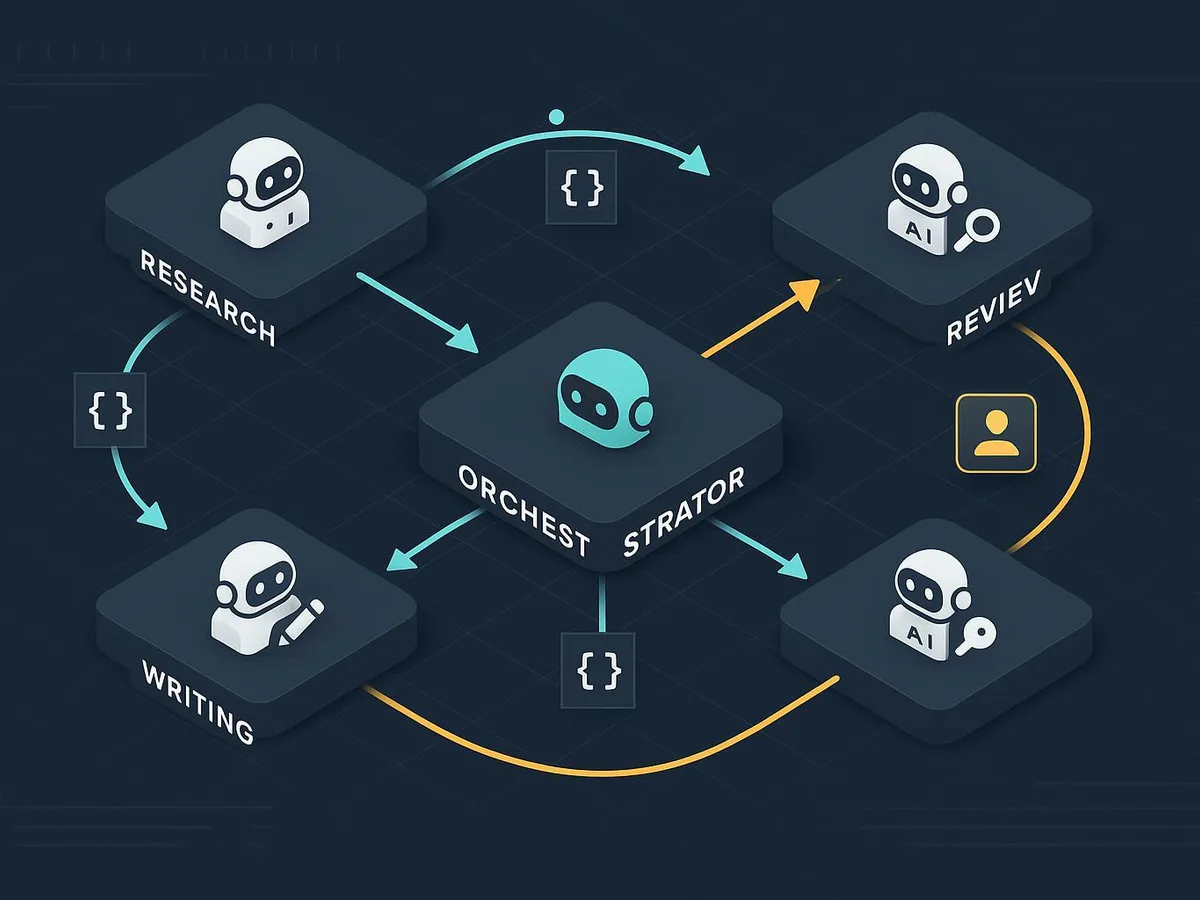
#3. Multi-Agent Orchestration
Complex workflows benefit from specialized agents:
- Planner — Decomposes goals
- Researcher — Queries APIs, scrapes, synthesizes
- Coder — Writes, tests, debugs code
- Critic — Reviews outputs for correctness, safety
Communication occurs via structured messages (e.g., JSON over a message bus). Microsoft AutoGen and CrewAI provide runtime environments for such topologies. Key challenge: avoiding "agent sprawl" where coordination overhead exceeds gains.
#Memory Architectures
Agentic systems require memory beyond the context window. Three tiers are emerging:
| Tier | Scope | Storage | Retrieval |
|---|---|---|---|
| Working | Current episode (minutes-hours) | In-context / KV cache | Implicit via attention |
| Episodic | Past interactions (days-months) | Vector DB (Pinecone, Weaviate) | Semantic search + reranking |
| Semantic | Learned facts, user models (permanent) | Knowledge graph / structured DB | Graph queries, SPARQL |
Practical tip: Start with episodic memory using a vector store. Embed conversation summaries (not raw logs) to control cost and noise. Use a nightly batch job to distill semantic facts ("User prefers aisle seats") into a structured profile.
#Tool Use: From Function Calling to Tool Ecosystems
Modern LLMs support function calling (OpenAI, Anthropic, Gemini, Mistral) — the model outputs a structured JSON blob matching a predefined schema. This is the backbone of tool use.
Best practices:
- Schema design: Keep schemas minimal. Prefer
type: stringwith description over complex nested objects. - Error handling: Tools must return structured errors (
{ "error": "rate_limited", "retry_after": 30 }) so the agent can reason about recovery. - Sandboxing: Code execution tools (Python, SQL) must run in isolated containers (gVisor, Firecracker) with network egress controls.
- Observability: Log every tool call with input, output, latency, and token count. Correlate with agent decision traces.
#Evaluation & Guardrails
Agentic systems are stochastic pipelines. Evaluation must cover:
- Task success rate — End-to-end completion on a held-out benchmark set (e.g., WebShop, ALFWorld, or internal golden tasks).
- Step efficiency — Steps per successful task; detect loops.
- Safety — Red-team for prompt injection, data exfiltration, unauthorized actions.
- Cost/latency — Token usage per task; tool call latency distribution.
Guardrails (not just eval) include:
- Action allowlists — Only approved tools callable per agent role.
- Human approval gates — For irreversible actions (payments, deletions).
- Circuit breakers — Max steps, max tool calls, max wall-clock time per episode.
#Engineering Considerations for Production
| Concern | Recommendation |
|---|---|
| Observability | Emit OpenTelemetry spans for each agent step; correlate with user session IDs. |
| Versioning | Version prompts, tool schemas, and agent graphs together (GitOps). |
| Testing | Property-based tests for tool contracts; simulation harnesses for agent trajectories. |
| Deployment | Deploy agents as stateless workers consuming from a task queue (Celery, Temporal, Kafka). |
| Cost control | Route simple queries to smaller models; escalate to larger models only for planning. |
#Conclusion
AI agents represent a shift from prompt engineering to system engineering. The most successful deployments today don't chase full autonomy — they embed agentic loops inside well-bounded workflows: a planner that proposes, a human that approves, an executor that acts, and a critic that verifies. As model capabilities improve, the boundary of "well-bounded" will expand. Engineers who invest now in observability, evaluation harnesses, and clean tool abstractions will be positioned to absorb each leap in model agency — without rewriting their architecture.
Related articles
 AI Agents
Understanding Codex Micro: The Evolution of Specialized AI Agents
An in-depth exploration of Codex Micro, analyzing how specialized, small-language-model (SLM) agents are replacing monolithic LLMs for precise coding and automation tasks.
 AI Agents
AI Agent Orchestration: The Architecture of Routing, Tool-Calling, and Human Handoff in Customer Support
An in-depth technical guide on building sophisticated multi-agent systems for customer support, covering intelligent routing, tool integration, and seamless human-in-the-loop transitions.
 AI Agents
The Velocity of Volatility: Why My AI Governance Book Needed Three Updates in Six Months
An exploration of the challenges of documenting AI governance in a hyper-accelerated landscape, detailing the shift from static frameworks to dynamic, iterative policy management.