
Moonshot AI's Kimi K3 is challenging the status quo by bringing advanced 'Slow Thinking' reasoning capabilities to the open-source community, rivaling proprietary giants.
For the past year, the narrative surrounding Large Language Models (LLMs) has been dominated by a stark divide. On one side, we had the proprietary "black boxes"—models like GPT-4o and Claude 3.5—which pushed the envelope of complex reasoning. On the other, we had the open-source movement, which offered transparency and flexibility but often lagged in high-level logical synthesis and "deep thinking."
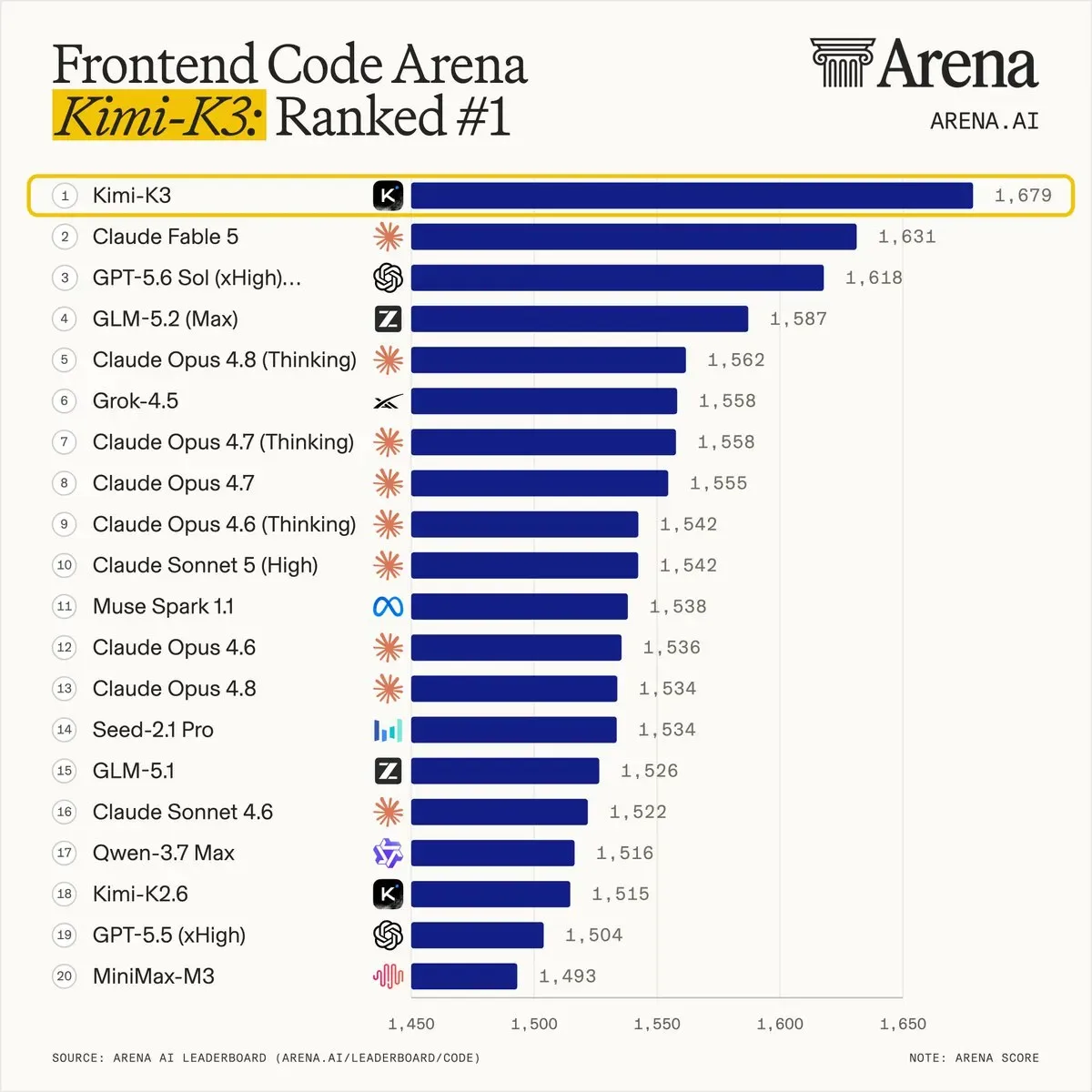
Then came Kimi K3.
Moonshot AI has introduced something that few expected from an open-weight approach: a model that doesn't just predict the next token, but actively reasons through problems using a sophisticated internal monologue. This shift marks a pivotal moment in the democratization of AI.
#The Shift from Fast to Slow Thinking
To understand why Kimi K3 is a breakthrough, we have to look at the psychology of AI. Most LLMs operate on what Daniel Kahneman calls "System 1" thinking—fast, instinctive, and emotional. They generate responses almost instantaneously based on patterns. While this is great for poetry or basic summaries, it often fails in complex coding, mathematics, or nuanced logical puzzles where a single leap in logic can derail the entire answer.
Kimi K3 integrates a version of "System 2" thinking. It employs a reinforcement learning framework that encourages the model to engage in a "Chain-of-Thought" (CoT) process before delivering a final answer. Instead of jumping to the conclusion, K3 iterates, self-corrects, and verifies its own logic in a hidden reasoning trace.
#What Makes Kimi K3 Different?
While other open-source models have tried to mimic reasoning via prompting (e.g., telling the model to "think step-by-step"), Kimi K3 is architected for it. The "unexpected" element here is the level of efficiency and accuracy it achieves without requiring the massive compute overhead typically associated with recursive reasoning.
#1. Advanced Long-Context Mastery
Moonshot AI has always been a leader in context window management. K3 leverages this by maintaining coherence over massive datasets, allowing it to reason across thousands of lines of code or lengthy legal documents without losing the logical thread.
#2. Self-Correction Loops
One of the most impressive feats of K3 is its ability to recognize a hallucination while it is happening. During its internal reasoning phase, the model can identify a logical contradiction and pivot its approach before the user ever sees the output. This drastically reduces the "confident lying" that plagues many open-source models.
#3. Open-Weight Accessibility
By making these capabilities accessible, Moonshot AI is effectively breaking the monopoly that a few Silicon Valley giants held over "Reasoning Models." Developers can now fine-tune a model that possesses an innate ability to think through problems, rather than just mimicking the style of a smart person.
#The Implications for Developers and Enterprise
Why does this matter for the average developer or business leader? The implications are profound:
- Autonomous Agents: For an AI agent to be truly autonomous, it must be able to plan. Kimi K3’s reasoning capabilities allow for better multi-step planning, making agents that can actually execute complex workflows without constant human hand-holding.
- Cost-Effective Intelligence: Companies no longer have to pay exorbitant API costs to proprietary providers to get "reasoning-grade" intelligence. They can deploy K3 on their own infrastructure, ensuring data privacy while maintaining high performance.
- Scientific Discovery: In fields like bioinformatics or materials science, the ability to reason through a hypothesis is more valuable than the ability to summarize a paper. K3 opens the door for open-source AI to contribute meaningfully to R&D.
#The Road Ahead: Is the Gap Closing?
For a long time, the consensus was that "True Reasoning" required a secret sauce of RLHF (Reinforcement Learning from Human Feedback) and compute scales that only the largest corporations could afford. Kimi K3 proves that the gap is closing.
However, challenges remain. The "reasoning trace" increases latency; thinking takes time. The trade-off between speed and accuracy is the next frontier. As the community begins to optimize K3, we will likely see a surge in "distilled" versions of these reasoning capabilities, bringing slow-thinking intelligence to edge devices.
#Final Thoughts
Kimi K3 isn't just another model release; it is a statement. It tells us that high-level cognitive architecture is no longer the exclusive domain of closed-source labs. By bringing "Slow Thinking" to the open-source world, Moonshot AI has accelerated the timeline for the next generation of intelligent software.
We are moving from an era of AI that answers to an era of AI that reasons. And for the first time, that power is in the hands of the community.